Information, Facts & Information of the Basenji
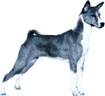
The Basenji, the famous bark-less dog, comes from Africa and is a dog of medium size, lightly built and fine boned with a wrinkled forehead, erect ears and a curly tail which sits on it's back. This dog is also known by the other names of Zande dog, Congo dog or Congo terrier. The Basenji was bred originally to drive game up trees (monkeys and small cats). They were also used to also chase prey such as small antelopes into hunting nets or out into the open where their quarry could be shot with a gun or a bow and arrow. It's origins can be dated back for at least 5000 years to the Ancient World. It is classified as one of the Hound Dogs Group which we go on to describe in detail in the section at the bottom of this page. This dog's name is sometimes mis-spelt as Basengi. Basenji Dog NamesThe Basenji - A Sighthound
The Basenji Hound belongs to the collection of dogs referred to as Sighthounds or Gazehounds, which specialise in hunting its quarry by sight rather than scent. All of the Sighthound breeds originated in the Middle East, Africa and Southwest Asia. It wasn’t until the mid 1500's that hounds began to be classified according to their purpose, i.e. sight hounds, scent hounds, etc. Sighthounds have distinctive characteristics, features and traits which are perfect for their purpose. Sighthounds have extremely good vision. They also have a long jaw and lengthy neck which assists them in sighting their quarry. Their lean muscular body, deep chest and long powerful legs essential assets when following any fast and agile prey. Sighthounds also have distinctive feet with elongated middle toes that make the foot appear longer and helps with their firm footing. Their long stride, powerful chest and lungs and agile bodies make it possible for sight hounds to chase and kill their quarry. As a pet the Basenji Hound is feisty, fastidious, playful and inquisitive. The strong instinct to chase and trail requires an excellent training program and firm control. Information, Facts & History of the African Basenji Hound Dog
The Pharaohs of Egypt kept Basenji Hound and references to the Basenji's ancestors appear as hieroglyphics and are also found engraved in cuneiform ( written in wedge-shaped characters) on ancient pillars and tablets. The breed was discovered, however, by the Western civilisation on the African Congo with the Pygmy tribe of hunters in the Zande area of Africa. This explains the other names of Zande dog, Congo dog or Congo terrier that the Basenji was known by. The name Basenji, or “bush thing,” was eventually chosen reflecting their African heritage. The pygmies and other African natives used the Basenji as a pack dog. As the dogs were ' bark-less' often wore large bells around their necks which assisted in the task of driving quarry into nets. Description of the African Basenji Dog and Puppies - Coat and Colours information
The Basenji's coat is short, sleek & fine. The colour is normally pure black & white, red & white, black tan & white with tan pips & mask, black, tan & white. Brindle, red background with black stripes. The white should be on feet, chest & tail tip. White legs, blaze & white collar optional. Dog Health information - potential health problems of the Basenjis
All owners of dogs and puppies are concerned about the health care of their pets and just as with humans dog health issues arise from time to time. Resolving dog health problems, including those of the Basenji, can prove to be costly and it would be wise to consider the benefits of obtaining dog health insurance. Diseases in dogs may occur because of trauma, infection, immune system abnormalities, genetic factors, or degenerative conditions. Common health problems and questions occur in relation to the Bones, Joints, Muscles, Nerves, Ears, Eyes, Teeth and the Mouth. Other, more serious, issues can relate to the Digestive System, Heart & Respiratory Systems, Immune & Blood Systems, Reproduction and Urinary Systems. Potential health problems of the Basenji may be checked via the Dog Symptoms Sorter, but can include:- Hip and Elbow Dysplasia (abnormal development of joints referred to as CHD - Canine Hip and Elbow Dysplasia)
- Fanconi syndrome
- Basenji enteropathy
Online Encyclopaedia of Common Dog Health Problems
Please click the following link for additional information which we have provided via our: Online Encyclopaedia of Common Dog Health Problems This describes the most common canine health problems concisely but simply without using medical jargon. A section on Dog and Puppy Vaccinations is also included offering information on each of the diseases, symptoms and effects for which immunization vaccines are available. Not sure of the name of the dog or puppy illness? A Dog Illness Symptoms Sorter is also featured. The Online Encyclopaedia of Common Dog Health Problems should only be used as an informational guide and when and if any dog or puppies health problems occur it is essential to raise any questions you may have with a Dog Health care professional. Description of the Basenji Dog and Puppies - Comparative Sizing Pictures & info
The pictures above allow for a useful sizing perspective between an average man (Five feet ten inches) or an average sized woman (Five feet six inches) in comparison to the average sized Basenji dog which we have detailed above. These pictures are extremely important as they provide an immediate and accurate visual representation of the height of an average Basenji compared to the height of a male or female - essential information but unique to this site. Use the pictures to help to estimate the size of the Basenji dog to each the various growing stages of children. Use the pictures to provide a guideline to the adult size of Basenji Puppies. The pictures will also prove to be invaluable when comparing the sizes and heights of other dog breeds. The dimensions will vary according to the sex of the dog or puppy. Girl dogs, or bitches, are on average, 2 inches smaller than boy dogs. Another useful piece of information when considering puppies. |