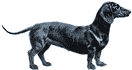
Information, Facts & Origins of the Dachshund
The Dachshund comes from Germany and is a dog which can be classed in three coat varieties and two sizes. It was bred originally to hunt badgers and other small game animals. It's origins can be dated back to the 1500's and it is classified as one of the Hound Dog Group which we go on to describe in detail in the section at the bottom of this page. Name Facts and Dog Names: This dog's name is often mis-spelt in a variety of ways including Dachhund, Dashshund, Dashhund, Dachund, Dashund, Dashound and Dachshound. Dachshund Dog NamesThe Dachshund - A Scent Hound
The Dachshund belongs to the collection of dogs referred to as Scent Hounds, which specialise in following the scent or the smell of its quarry. It wasn’t until the mid 1500's that hounds began to be classified according to their purpose, i.e. sight hounds, scent hounds, etc. Scent Hounds have distinctive characteristics, features and traits which are perfect for their purpose. They have large noses which have deep, open nostrils and their lips are loose and moist, designed to pick up scent particles and follow the trail of an animal. Their ears are long which concentrates the scent on the nose. Their bodies are designed for endurance, an essential asset when following any scent trail. Hunting takes different forms and as man opts for hunting their quarry either on foot or on horseback the scent hounds have been selectively bred to produce small legs, to enable a man to easily follow on foot, or longer legs suited to keep up with a man on horseback. Most scent hounds were used in packs - making a loud, deep baying noise alerting hunters to their location. As a pet the Dachshund is brave, kind, curious and loves to be part of the family. Information, Facts & History of the Dachshund Dog
The unforgettable outline of the Dachshund is world famous. It is colloquially, and affectionately, known as the Sausage or the Hot Dog. Dachshund translates from German to "badger dog" - Dachs being the German word for badger and Hund the word for hound. The standard dog is also known as the Teckel and the miniature is known the Zwergteckel. Although the breed is famous for its use in exterminating badgers, Dachshunds were also commonly used for rabbit and fox hunting. The Dachshund can be traced back to the 16th century in Germany. They have been kept by royal courts all over Europe, including that of Queen Victoria, who was believed to have been introduced to the breed by the German Prince Albert. The three types of coats and standard and miniature sizes were bred for different purposes: - Smooth Haired - Crossed with pointer and pinscher specialising in catching vermin
- Long Haired - Crossed with Spaniels to obtain the longer coat for colder climates
- Wire Haired - Crossed with German wirehaired pinschers and the Dandie Dinmont terrier
- Miniature - Bred to 'go to ground' into burrows of small animals
As a member of the Hound Group of dogs the Dachshund was at one time used to hunt in packs - their quarry was the Wild Boar. The Dachshund whether classed as Standard or Miniature sized has evolved into the popular house dog that it is today - the Dachshund is free from "doggy" odour. The Dachshund was first registered by the AKC (American Kennel Club) in 1885. Description of the Dachshund Dog and Puppies - Coat and Colours info
The Dachshund's coat comes in a range of any solid colours, two colours & brindle. Its coat can be smooth haired - short & smooth, long haired - soft & wavy, wire haired - harsh & short. Dog Health information - potential health problems of the Dachshunds
All owners of dogs and puppies are concerned about the health care of their pets and just as with humans dog health issues arise from time to time. Resolving dog health problems, including those of the Dachshund, can prove to be costly and it would be wise to consider the benefits of obtaining dog health insurance. Diseases in dogs may occur because of trauma, infection, immune system abnormalities, genetic factors, or degenerative conditions. Common health problems and questions occur in relation to the Bones, Joints, Muscles, Nerves, Ears, Eyes, Teeth and the Mouth. Other, more serious, issues can relate to the Digestive System, Heart & Respiratory Systems, Immune & Blood Systems, Reproduction and Urinary Systems. Potential health problems of the Dachshund may be checked via the Dog Symptoms Sorter, but can include:- Intervertebral disc disease
- Epilepsy
- Entropion (the inversion, or turning inward, of the border of the eyelid against the eyeball)
- Gastric Torsion
- Patellar Luxation ( The patella, or kneecap, is part of the stifle joint (knee). In patellar luxation, the kneecap luxates, or pops out of place )
Online Encyclopaedia of Common Dog Health Problems
Please click the following link for additional information which we have provided via our: Online Encyclopaedia of Common Dog Health ProblemsThis describes the most common canine health problems concisely but simply without using medical jargon. A section on Dog and Puppy Vaccinations is also included offering information on each of the diseases, symptoms and effects for which immunization vaccines are available. Not sure of the name of the dog or puppy illness? A Dog Illness Symptoms Sorter is also featured. The Online Encyclopaedia of Common Dog Health Problems should only be used as an informational guide and when and if any dog or puppies health problems occur it is essential to raise any questions you may have with a Dog Health care professional. |